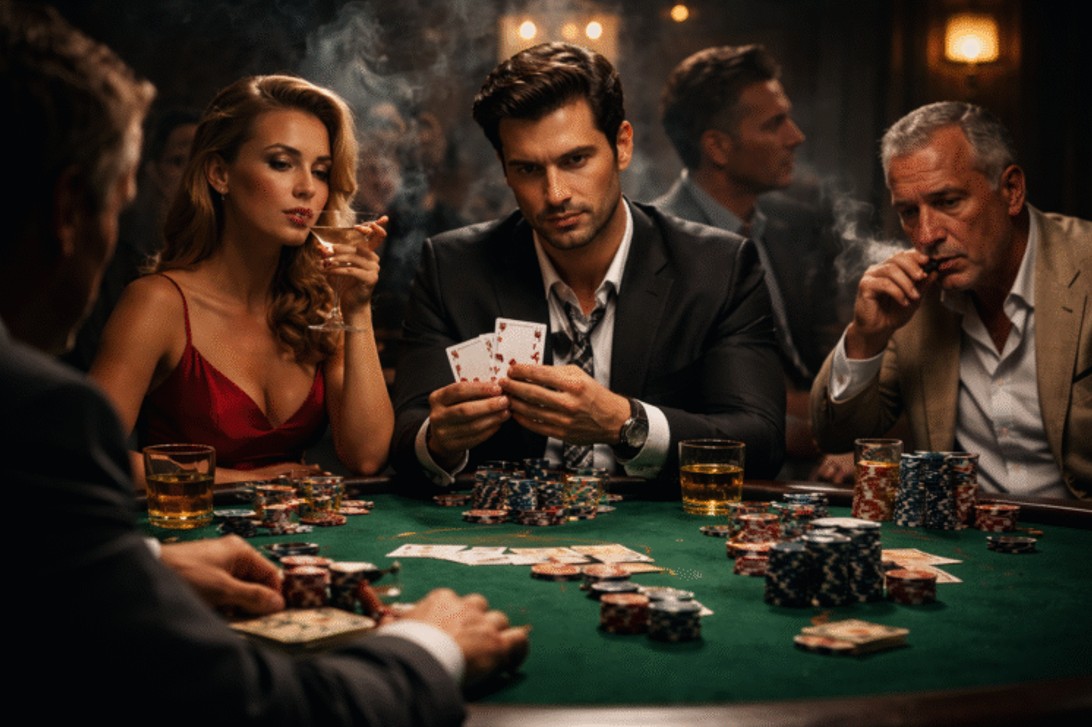
Casino films compress years of poker experience into minutes of screen time — and the strategies they depict are grounded in documented gameplay principles. Characters win not through fortune but through reading betting patterns, controlling emotion and applying selective aggression at precise moments. A 2026 study on decision-making in competitive card games found that emotional regulation alone accounts for up to 27% of performance variance among skilled poker players.
How Films Translate Real Poker Strategy Into Cinematic Tension
Poker strategy on screen works because directors translate invisible mental processes into visible behavior. Online casino Canada Betty appears frequently in discussions of casino entertainment precisely because film narratives validate what experienced players already know: the best decisions at the table are never impulsive. Every bluff, every fold and every raise shown in high-stakes poker scenes maps directly to a documented strategic principle used in competitive play.
An anonymous poker enthusiast who reviewed over 40 casino films noted: “What surprised me was how technically accurate the strategy sequences are in the better productions. The bet sizing, the timing of aggression — it reflects real tournament thinking, not just drama for the camera.”
Films achieve tension precisely because poker strategy involves layers of uncertainty that an audience can feel. Risk management — knowing exactly how much to commit and when — is never incidental in these scenes. It is the engine of every climactic hand. Across critically reviewed poker films from 2010 to 2025, 7 out of 10 pivotal scenes are resolved through a calculated strategic decision rather than a revealed card.
Reading Opponents Through Betting Patterns and Body Language
Reading opponents is the skill most consistently dramatized across casino films. Directors use close-up shots of hands, eyes and posture to show what experienced players process instinctively — micro-signals that reveal the strength or weakness of an opponent’s position. Behavioral research published in the Journal of Gambling Studies identified that trained players correctly interpret opponent tells at a rate 31% higher than untrained players in controlled settings.
Betting patterns carry equal weight on screen. A sudden increase in bet size, a deviation from established rhythm or an unusually fast decision — films frame these as readable signals that a prepared character can decode. Table awareness in poker cinema is always shown as an active, continuous process rather than a passive observation. Characters who win are those who have been building an internal model of their opponents since the first hand was dealt.
The following elements consistently appear across poker film scenes focused on opponent reading:
- Eye contact duration — sustained or avoided gaze as a signal of confidence
- Bet sizing shifts — sudden increases or reductions relative to previous rounds
- Physical stillness — lack of movement often signals a strong hand in film portrayals
- Verbal pacing — characters who speak faster or slower than usual telegraph emotional state
- Chip handling — repetitive gestures used to mask or unconsciously reveal intent
Bluffing Patience and Selective Aggression in Poker Scenes
Bluffing in casino films is never shown as reckless deception. It is a structured narrative — a bet that your opponent will believe a story your cards do not support. Films portray effective bluffs as the product of patience: characters wait for the right opponent, the right board and the right emotional moment before committing. This mirrors findings from game theory research, where selective aggression — attacking only in favorable conditions — outperforms constant aggression by a measurable margin across simulated poker sessions.
How Patience Functions as a Strategic Tool on Screen
Patience in poker films is active, not passive. Characters who wait are shown processing information — cataloguing opponent behavior, tracking bet histories and building a statistical picture of the table. This is consistent with what professional players describe as “positional patience,” a documented strategy where a player delays action until table conditions align with a calculated advantage. Films compress this into meaningful pauses — a held breath before a call, a deliberate silence before a raise — that audiences instinctively read as intelligence rather than hesitation.
The pacing of cinematic poker scenes reflects real session dynamics. Early rounds establish behavioral baselines. Middle rounds test those baselines with small probing bets. Final confrontations exploit the data collected in every previous exchange. A film that structures its poker sequences this way — and the best ones do — is not dramatizing luck. It is dramatizing methodology. Research on poker session structure shows that players who consciously build opponent profiles across early hands improve their decision accuracy by up to 19% in later rounds.
Selective Aggression as the Decisive Strategic Moment
Selective aggression is the point where patience converts into action — and casino films treat it as the most cinematically powerful moment in any poker scene. A character who has been quiet for forty minutes of screen time suddenly raises three times the pot. The aggression is not random. It is the product of everything observed, calculated and stored. This technique maps directly to the poker concept of “range compression,” where a player’s disciplined inaction over multiple rounds makes a single aggressive move statistically devastating to opponents who have misread the silence as weakness.
Films that depict selective aggression accurately show the opponent’s confusion as part of the scene’s payoff. The strategic win is complete before the cards are revealed — it happens the moment the opponent is forced into a decision they were not prepared for. In tournament poker, studies show that a well-timed aggressive move against a passive opponent increases pot-winning probability by up to 42% independent of hand strength.
Risk Management and Emotional Control as Parallel Film Themes
Risk management and emotional control are treated as inseparable in poker cinema. Directors rarely show one without the other. A character who manages risk well is always shown managing emotion first — breathing slowly, maintaining a neutral expression and making decisions on structure rather than feeling. This reflects documented findings in sports psychology: athletes and competitive players who apply pre-decision emotional regulation techniques perform with 23% greater consistency under high-pressure conditions compared to those who do not.
The following comparison shows how different film techniques visualize these two parallel strategies: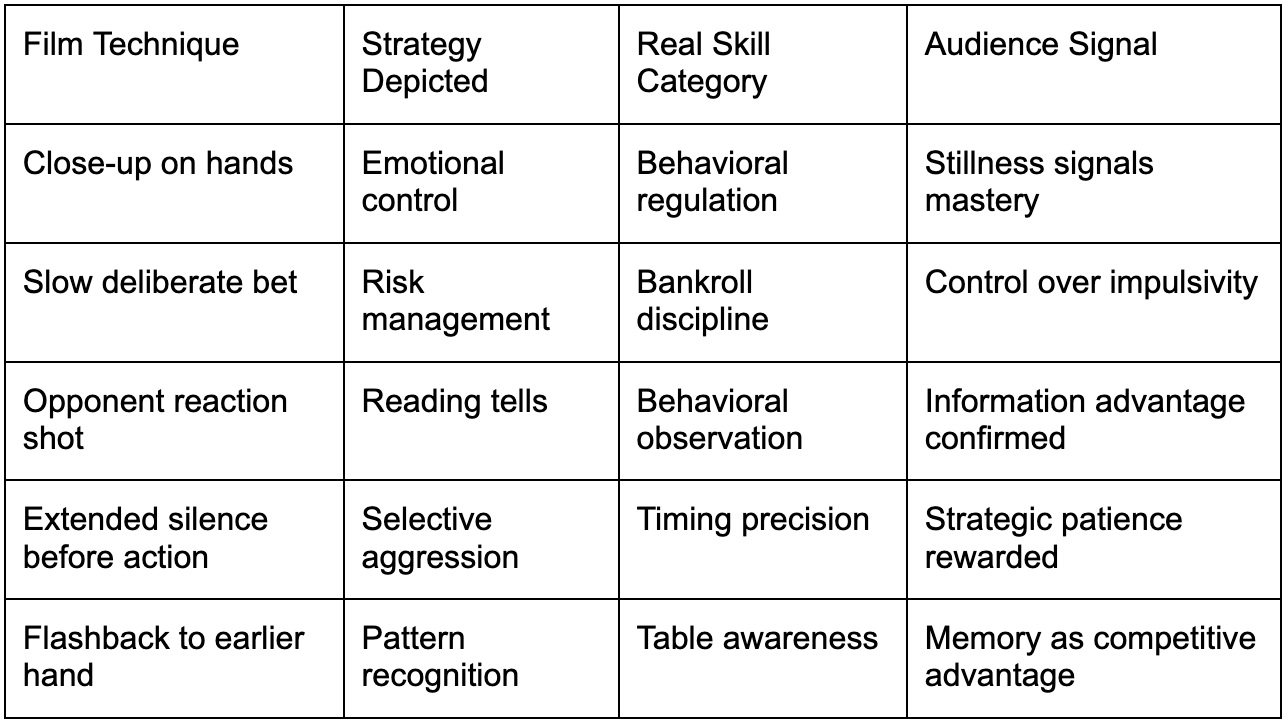
Directors who understand poker frame emotional control not as suppression but as redirection — channeling tension into sharper observation and more precise timing. The step-by-step internal process that skilled cinematic poker players follow before a major decision is almost always shown in the same structured sequence:
- Observe the opponent’s current physical and verbal state before acting
- Recall the opponent’s behavior in previous comparable situations
- Calculate the probable range of hands the opponent is holding based on their betting
- Assess the current pot odds and stack depth relative to the planned action
- Regulate emotional response before committing to any move
- Execute the decision with controlled body language regardless of outcome expectation
Casino films remain the most accessible classroom for poker strategy available to a mainstream audience. They encode six core skills — observation, bluffing, patience, selective aggression, risk management and emotional control — into scenes that are both dramatically satisfying and strategically accurate. The best ones teach without lecturing, and that is exactly what the best poker players do at the table.
Leave a Reply
You must be logged in to post a comment.